A new era of exam scheduling has arrived. We’re proud to introduce Infosilem Exams
The Design of a Viable Pattern System
Introduction
This paper discusses suggested harmonized teaching pattern structures which when consistently applied at your institution optimize space usage and more importantly student access to courses.
Teaching patterns are the various blocks of time that individual course deliveries follow during the week. Typical patterns include 3 by 1hr, 2 by 1.5hr, 3 hr block; however, anything goes. The choice of meeting patterns must meet the needs of the course material being taught as well as any curriculum requirements. Institutional space is finite, and the teaching week is limited, therefore it is important to consider optimization of teaching patterns in order to make the best use of limited resources while at the same time ensuring student access to courses that they need or want to take.
The following pages focus on optimizing the most common teach patterns within a typical 9-hour teaching day. There are many other patterns that are used across institutions including “floating” timeblock patterns but they are outside the scope of this document.
Read on to explore teaching pattern optimization!
Rules Of Optimization
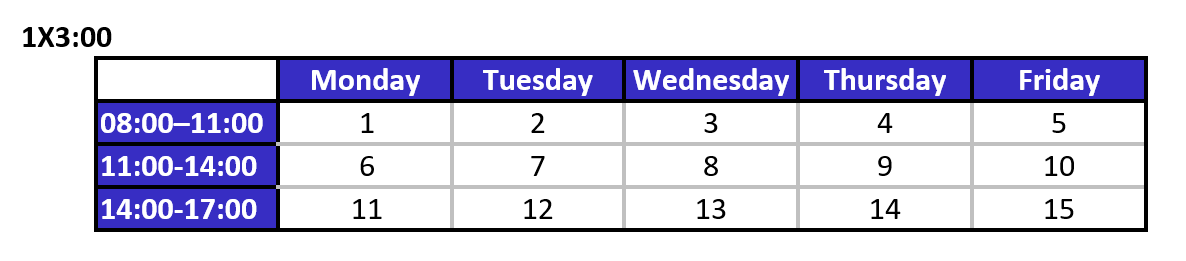
When trying to find an optimal pattern system, the general rule is that the more varied the possible offerings are in terms of duration and combinations, the less optimal the system will be. Consequently, this means that a pattern system that includes only one duration (e.g. 3 hours) and allows for only one method of offering this duration (e.g. 1 times 3 hours a week), will be the most optimal pattern system. It does not matter what the actual duration is, as long as it’s the same across the board. The following table gives a graphical representation of this.
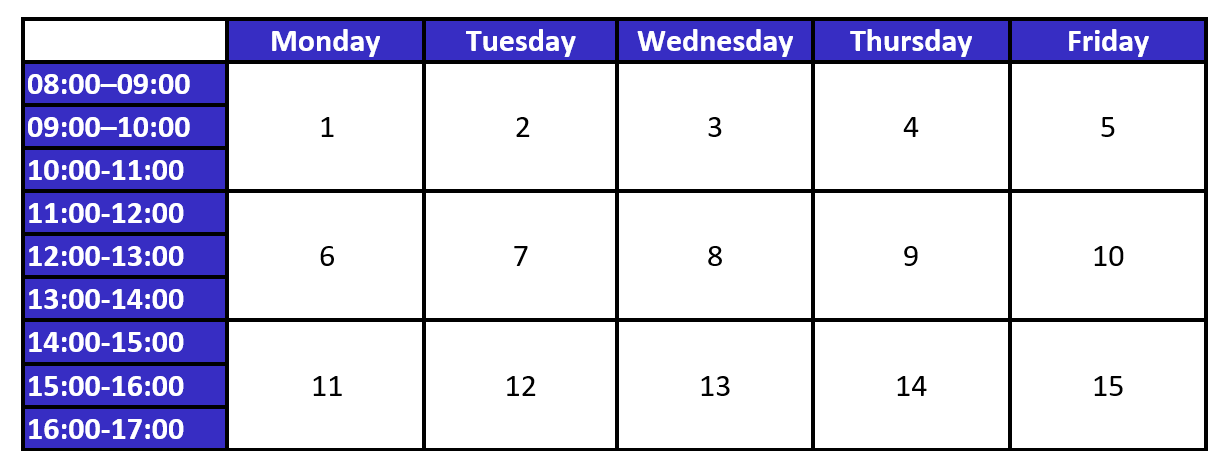
We can see that by offering courses this way we can extract the most out of any resource. In this case, we are able to offer 15 – 3 hour classes in any room. Some would argue that if we offered our 3-hour courses every hour, we could have 35 offerings but this is misleading. If we keep with our grid, the most 3-hour courses that can fit in any one week is 15. If you tried to schedule one of those 3-hour courses at an offset start time, you would be left with a remainder of 13 courses that could fit. This reduces the total from 15 to 14.
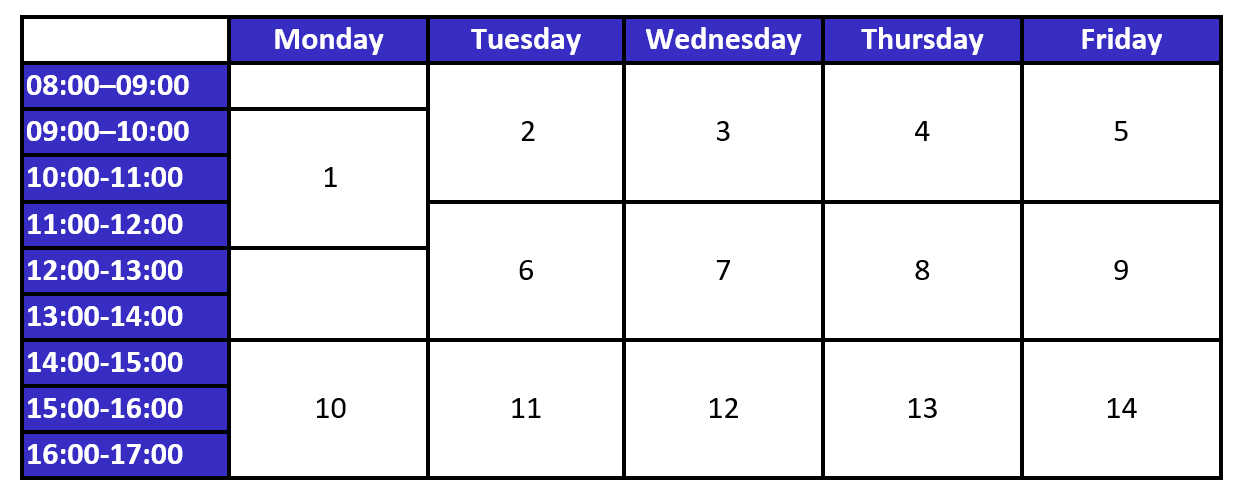
Another criteria, therefore, in an optimal pattern system, is to avoid overlapping your patterns. In other words, you want to minimize the effect that any one pattern will have on the other patterns.
Obviously, offering all your courses in this manner is not a viable solution for any institution since it lacks the flexibility that departments need when offering their courses. We must therefore find a balance between flexibility and optimization to produce a viable pattern system for the institution.
How Institutions Offer Their Courses
Most institutions have a set rule as to the number of hours a week that a course must be offered and this is normally linked to the credit value of a course. How this duration is broken up is usually left to the departments but most often it is offered once a week for the full duration, twice a week for half duration or three times a week for 1/3 duration. For example, a 3-hour duration could be offered 1X3:00, 2X1:30 or 3X1:00
Other common requirements are:
- If the course is offered twice or three times a week, all pieces should have the same start time.
- If the course is offered twice or thee times a week, there should be a day in between the offerings.
We will see that these requirements limit the flexibility and optimization of the pattern system. We will also see how these requirements along with different patterns systems can greatly affect the availability of resources (including rooms).
With this knowledge, institutions have generally adopted a pattern system that offers their 3X1:00 courses M,W,F and their 2X1:30 courses T,H. Their 1X3:00 courses would be left to schedule any time during the week as long as it did not overlap on too many of the other patterns. A table representation of this would be as follows:
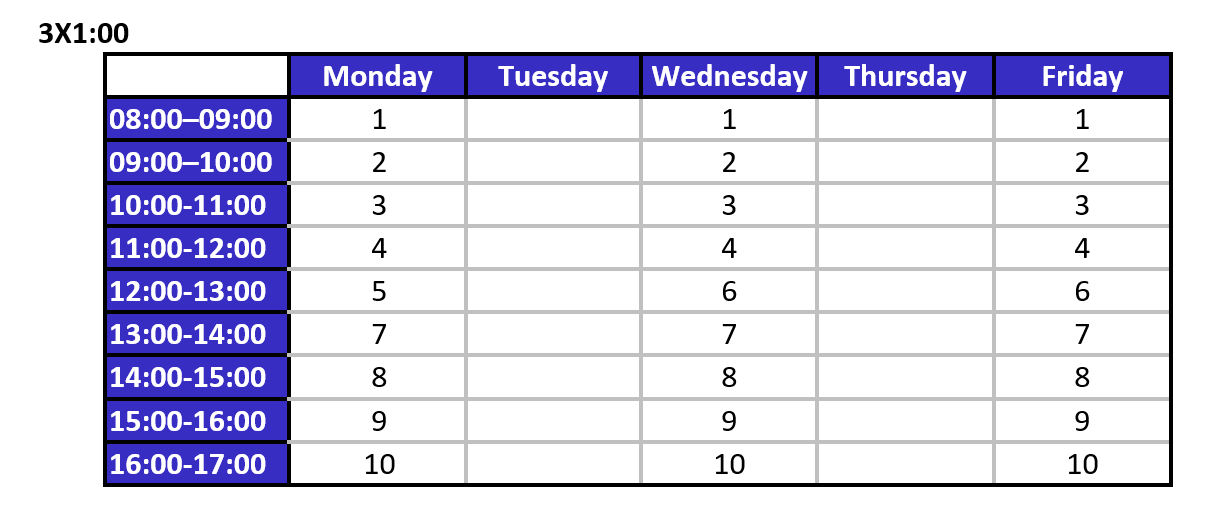
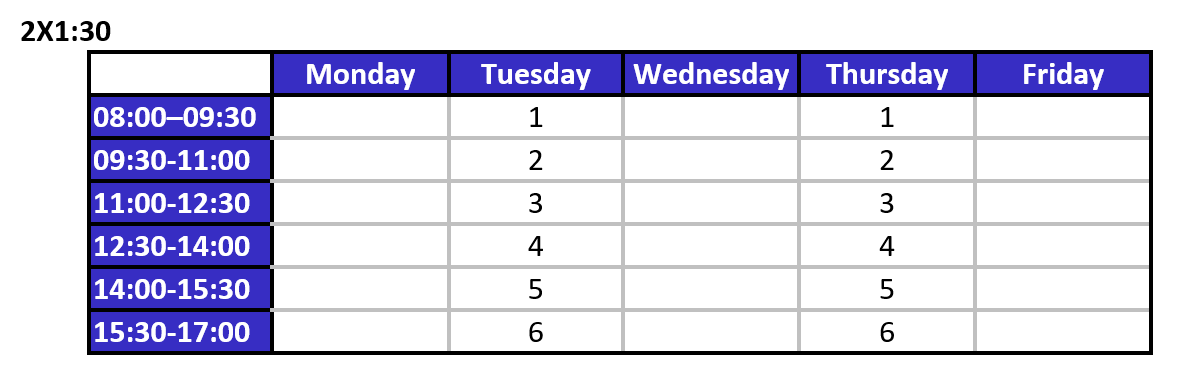
Since the 3X1:00 classes would never overlap the 2X1:30 classes, this method partly respects the requirement to minimize the effect of one pattern on another. However, the same can not be said for the 1X3:00 classes. As soon as you schedule one of these 3:00 classes, you are eliminating all three or all two of the 3X1:00 or 2X1:30 classes respectively at that time for the whole week.
For example, the 1X3:00 option 1 eliminates options 1, 2 and 3 of the 3X1:00 pattern. This will therefore ‘waste’ Wednesday and Friday for the room.
This system is also not very flexible for the departments. If for some reason the students or the instructor is unavailable on a certain day, then all offerings related to them have to be 3X1:00 or 2X1:30 depending on the day. It should also be recognized that not many people like Friday classes which puts more pressure on the 2X1:30 pattern which, incidentally, is the one that offers the least amount of options.
This scenario has forced institutions to accept many exceptions to the standard pattern and this, in turn, leads to inefficient use of an institution’s resources.
What To Do
From the above information, we know we have to improve on two major things, flexibility as to when the courses can be offered and minimize the effect that one pattern will have on the others to improve optimization. A lesser goal, but still sometimes significant, is to eliminate the preference for one pattern over another because of the days that it is offered (or not offered).
If we continue with the example that our classes are offered in 3-hour durations that are broken up into 3X1:00, 2X1:30 or 1X3:00, we can see that they all fit into a 3-hour block and since most day schedules run from around 08:00 to 17:00 (a 09:00 duration) we can use that symmetry to break up the day into 3 time blocks of 3-hours each and add one evening block if necessary.
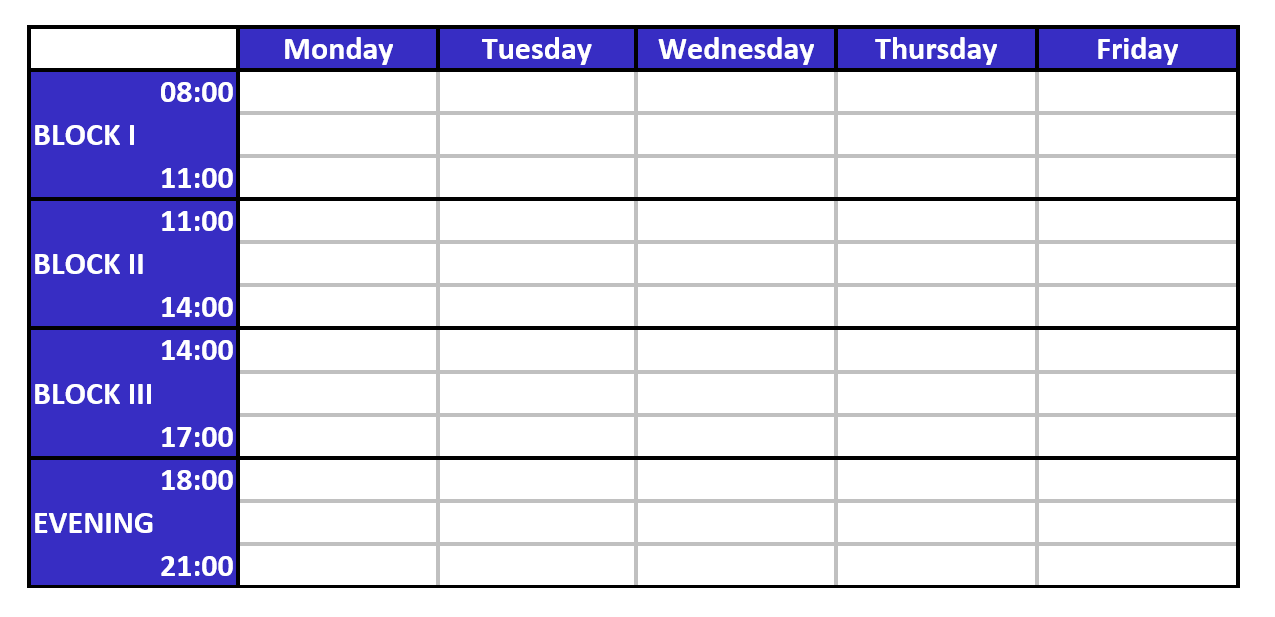
The advantage of setting up these blocks and making sure that our patterns do not overlap blocks is that it will minimize the effect that any one pattern will have on others. It also makes it easier to setup guidelines for forced times and blockoffs. As long as the forced time or blockoff fits within a block, its effect will be lessened.
The goal now is to setup our patterns within a block so that they give departments flexibility, optimize the use of time for any resource and do not overlap into another block. Once done, the results can be duplicated into all blocks. We will therefore concentrate on BLOCK I to setup our patterns.
1X3:00
This is the simplest pattern since all we need to do is offer it once within a block every day of the week. In a table it looks like this:

2X1:30
This pattern was typically offered T,H twice within a block. To add more flexibility and optimization while still leaving a day in between offerings, it could also be offered M,W and W, F. This also alleviates the predisposition to pick this pattern because it did not contain a Friday offering. In a table it looks like this:
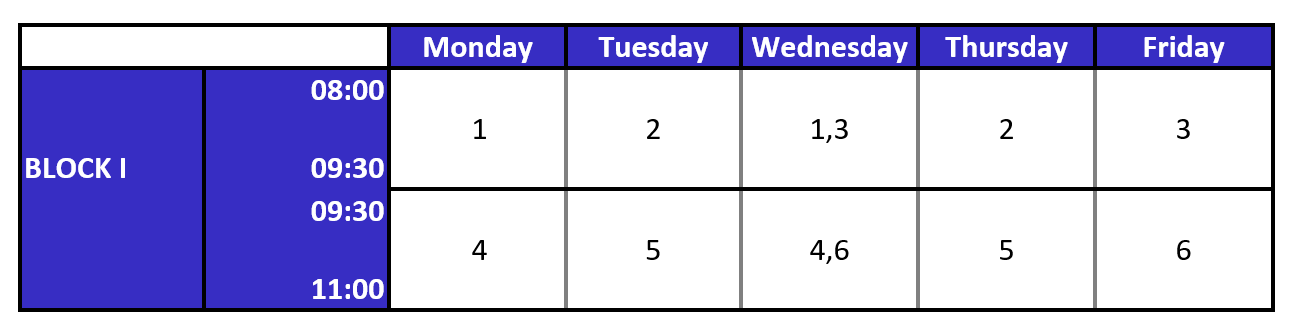
Note that we could also offer the course M,F but we will eliminate this possibility since, if used, it would not allow for another 3X1:00 pattern during the same time frame (see below).
3X1:00
This pattern is the one that will change the most. Because it takes up three days out of the five week days, it can only be offered M,W,F three times in a block if we keep the requirement that there be a day in between all offerings. If, however, we relax this and say that we do allow two of the offerings to be on consecutive days, then we have a lot more options. The courses could therefore be offered M,T,H or M,W,F or T,H,F. In a table it looks like this:

Note that a few more combinations are possible but if used these would not allow for a 2X1:30 pattern to be used during the same time frame.
Within a block we can now see that using any one pattern does not mean that all other patterns are unavailable and yet we are still offering plenty of flexibility for all our patterns.
For example, the 1X3:00 option 1 only eliminates options 1 and 4 of the 2X1:30 pattern and leaves 2, 3, 5 and 6 available. As well, it only eliminates options 1, 2, 4, 5, 7 and 8 for the 3X1:00 pattern and leaves 3, 6 and 9 available.
If we now take the results of BLOCK I and continue our logic into the other blocks, we get the following results.
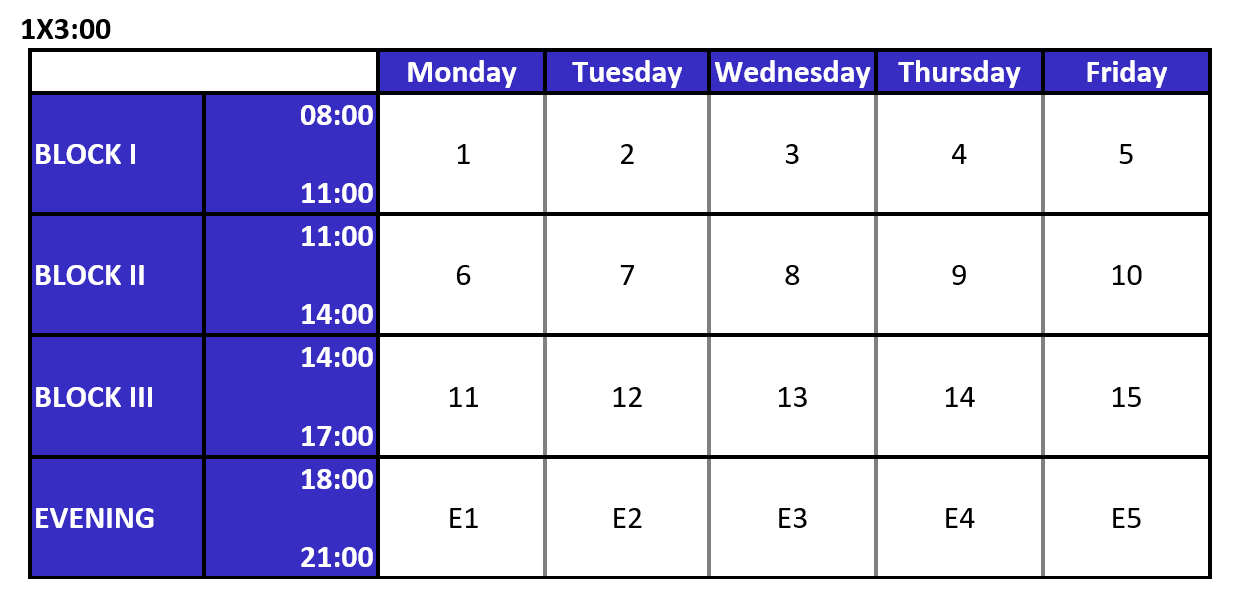
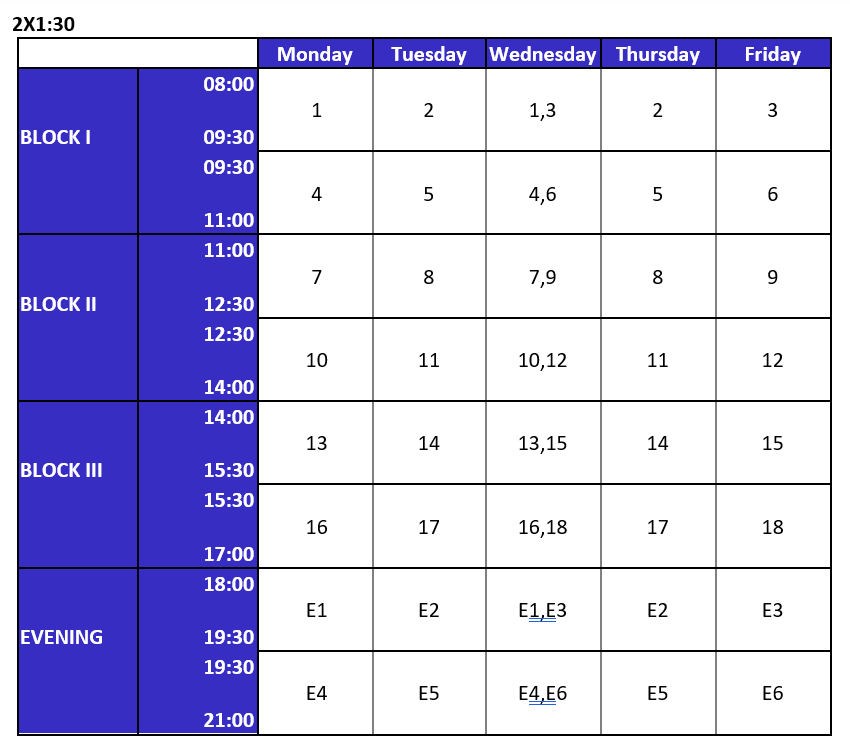
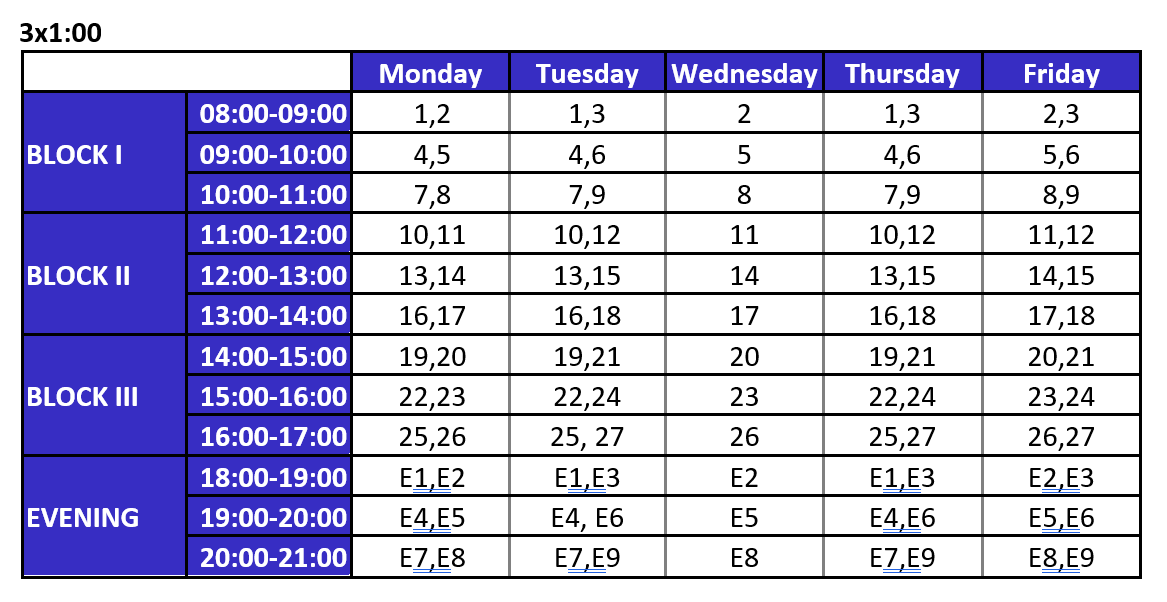
Up to this point we have assumed for our examples a day range of 08:00-17:00 an evening range of 18:00-21:00, a course duration of 03:00 and a travel time that is imbedded into the course duration. Although it is a good approximation, it is not always the case. Depending on the institution, course duration and travel time may vary. Time ranges are then usually determined by the outcome of these values.
Because the 3X a week offering is the one that causes the most course switches within a block, it is the one that will be the most affected by travel time and so it is the one that will determine the outcome of the others. If we determine that the students and staff need a minimum of 10min travel time between classes and that the actual class time is a 3X0:50, then the actual duration from the start of one class to the start of another is 0:50class+0:10travel = 1:00. 2X a week courses in the same system would therefore be 2X1:15 with a 15min travel time and 1X a week courses would be 1X2:30 with a 30min travel time (or maybe a 15min break in the middle of the course + a 15min travel time). In a table it looks like this:
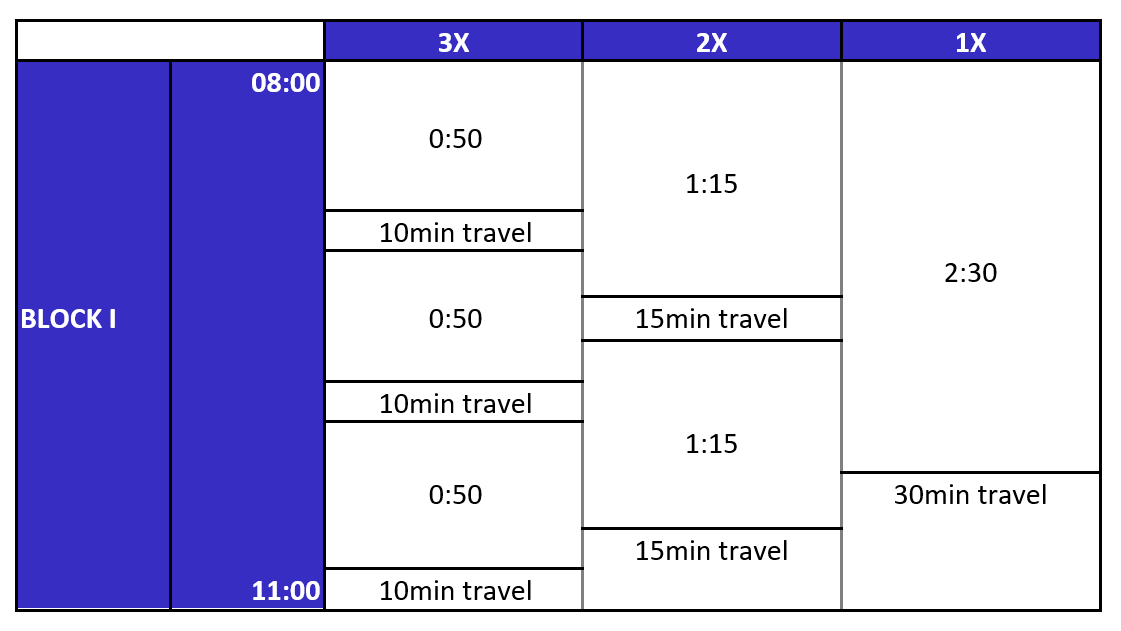
This setup follows the example we used in our other tables. If, however, a different travel time is required or the contact time is not the same, then all that is needed is a simple recalculation of the blocks and the duration of the day as a whole. For example, if a minimum 15min-travel time were required, then the total elapse time of each block would be 3:15. The day and evening range would then be adjusted to start or end earlier in order to accommodate the difference.
Exceptions
Giving departments more flexibility as to how they offer their courses will cut back on the need for exceptions but the reality is that there will always be a need for them. Apart from trying to limit them, the key to exceptions is to try to keep them within the logic of your pattern system. If a course needs to have a forced time, then all effort should be made for it to follow one of the patterns. If this is not possible, then it should follow the blocks and avoid overlapping.
If a course does not need to be forced but simply does not adhere to the common 1X, 2X or 3X patterns, then we can either create a new pattern that follows an existing pattern or we can use a combination of the existing patterns. For example, if a course needs to be scheduled 2X1:00 in the week, then we can setup a pattern system 2X1:00 whose options are subsets of the 3X1:00 pattern.
Other University Models
Up to this point we have produced a pattern system that adheres to the requirement that if a course is offered 2X or 3X a week, it must have the same start time every day. It was also noted that this requirement reduces the possible optimization of your resources.
If, at an institution, the culture permits it, dropping this requirement opens the door to a completely new set of possible pattern systems. One of those possibilities is a pattern system that was developed by Queen’s University of Kingston, Ontario, Canada.
In the 1960s Queen’s University did a similar, if not more in depth, analysis of this problem. The result was a very flexible and very optimal pattern system. The draw back, however, is that it breaks the rule of always having a day in between offerings (3X a week only) and always having the same start time (stays within a block however). The system can be better explained by presenting the tables for the 1X, 2X and 3X patterns within BLOCK I:
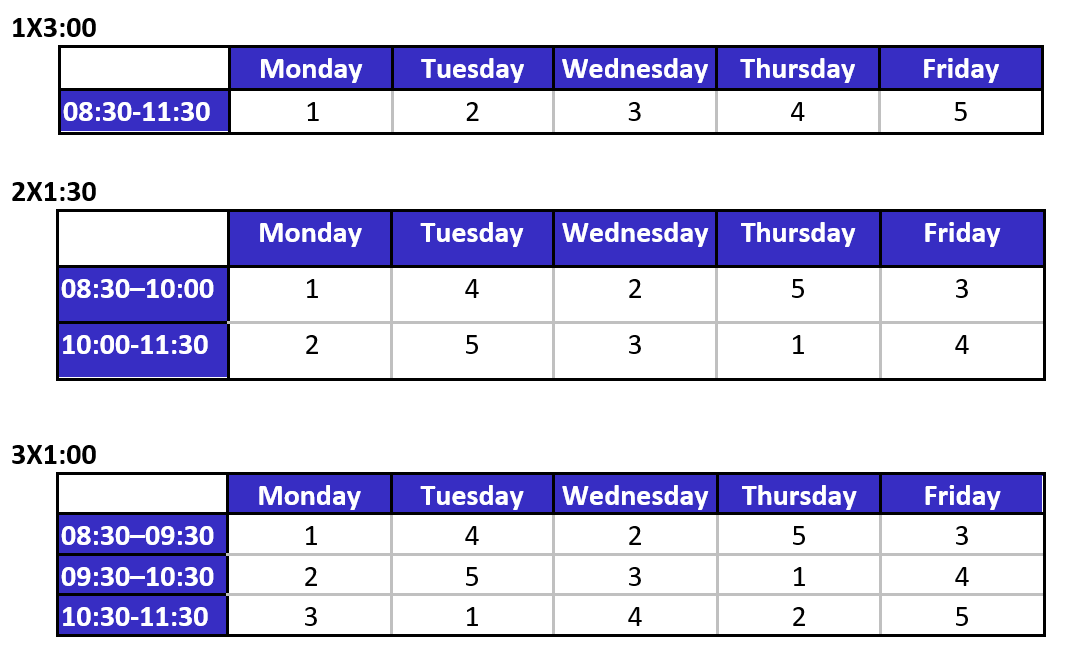
We can see that instead of having only a maximum of 4 – 2X1:30 non-overlapping patterns within a block, we can now fit 5 of them. Plus, instead of only having a maximum of 3 – 3X1:00 non-overlapping patterns within a block, we can now also fit 5 of them. We can also see that the placement of the 2X patterns minimizes the effect that they would have on the 3X patterns.
For example, the 2X option 1 is placed so that it only eliminates option 1 and 2 of the 3X pattern. Placing it at different times could have eliminated up to 4 of the 3X options.
Conclusion
The choice of teaching pattern structure has a significant impact on student access to courses (and therefore progression) as well as room utilization. Scheduling teams are constantly pressured to better optimize their next schedule; whether it is improving room utilization, or better accommodating instructors, or maximizing student choice….meeting patterns often remain an overlooked factor when evaluating how to improve your institution’s schedule.
Patterns are usually inherited, rarely established by the scheduling team using them, and the effects of poor meeting patterns are often ignored under the guise of “it’s just the way things are”.
We hope this article has shed some light on the subject and spurs you to consider the importance of harmonized teaching patterns.
Let us help you
simplify  your process
and maximize  your
your
efficiency
Contact an Infosilem Higher Education expert to
learn more about our solutions

2130 Dagenais Blvd. W,
Suite 200,
Laval (Quebec)
H7L 5X9


